Lessons from the Crypto Counterparty Front Lines
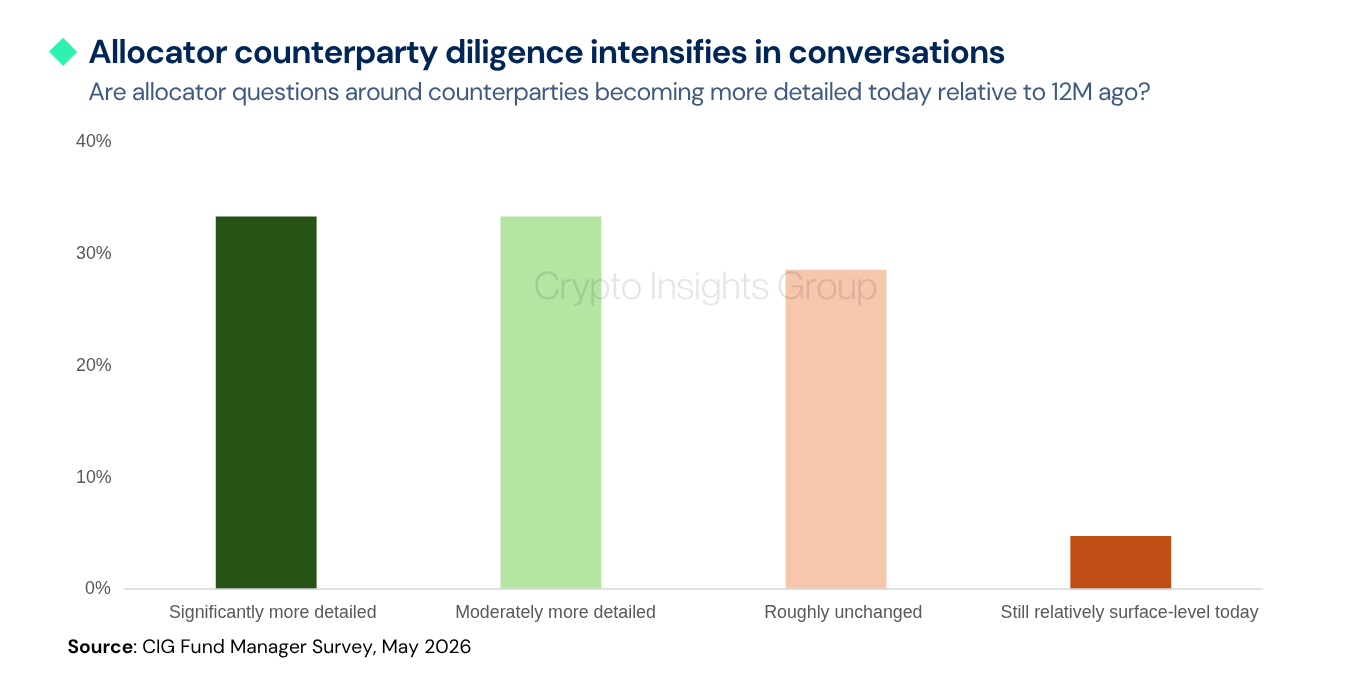
Crypto counterparty risk has moved from an onboarding question to a real capital-allocation constraint. Allocators want evidence that managers can monitor, limit, and move exposures in real time; managers need counterparties willing to provide institutional-grade transparency; and venues that can meet that standard will be better positioned as institutional capital returns to digital assets.
Over recent months I’ve written a number of pieces addressing both the needs and requirements for conducting crypto counterparty due diligence, the basis of which was driven by conversations, including:
- Concerns from institutional allocators expressing dissatisfaction, or apprehension, about digital asset managers’ initial and ongoing counterparty due diligence processes, often revealed during operational due diligence reviews.
- Investment managers asking Crypto Insights Group how best to respond to client DDQs, which request details on how counterparty risk is managed.
- Crypto counterparties, such as brokers, exchanges, custodians, liquidity providers and others, who are receiving requests from account holders, auditors, and occasionally regulators, on providing details on the counterparty’s operations, organizational structure, financial standing and conflicts.
- Traditional investment institutions looking to allocate in the crypto market space, but having internal compliance and risk teams sensitive to past crypto counterparty failures.
- A general “wait and see” position from some of the profiles above, and other professional market participants, who are hinging their entry point on “Clarity [Act]” (pun intended) of regulatory decisions or finalization of laws.
In addition to the above, there remains a near constant interest in understanding what solutions exist to address an ongoing matter in the space with respect to counterparties, which is a default lack of transparency with certain organizations.
The transparency issue, to state it plainly, puts many fund managers and their clients in the difficult position of being unable to properly assess the risk of trading with certain brokers and exchanges, as such counterparties offer the only venues for which certain crypto strategies can effectively be executed, and therefore those market dynamics can reduce the incentive for certain venues to provide institutional-grade transparency.
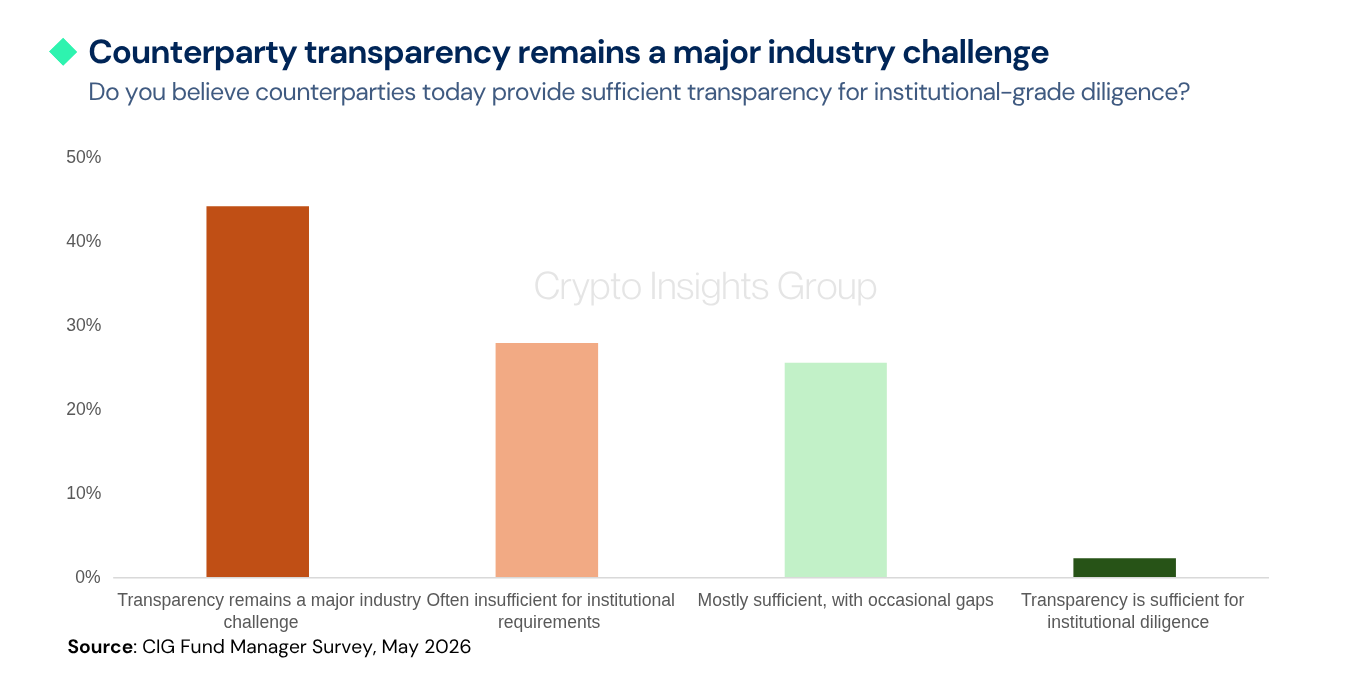
To be more specific, for those strategies that may simply be spot-price trading and assume that a risk may be diminished or mitigated as such, they too play the odds of a counterparty being overwhelmed and unable to support an orderly book if nearly all of their accounts are demanding settlement instantaneously during a liquidity event.
.png)
Lastly, due to some of the factors identified above, counterparty concentration is also clearly becoming a systemic issue. Within Crypto Insights Group’s research and data analysis, the fact of having many counterparties not meeting institutional standards is driving a large share of investment managers to engage with a smaller group of trading participants. Coupled with constant news of industry consolidation, this pattern creates a self-reinforcing effect of lowering the ability to diversify trading risk and building a “too-big-to-fail” phenomenon
Tactics for Effective Counterparty Risk Management
In a previous Crypto Insights Group piece I wrote, entitled “A Roadmap for Managing Crypto Counterparty Big Bangs,” I presented examples of what information a counterparty client should request, and means for ongoing monitoring.
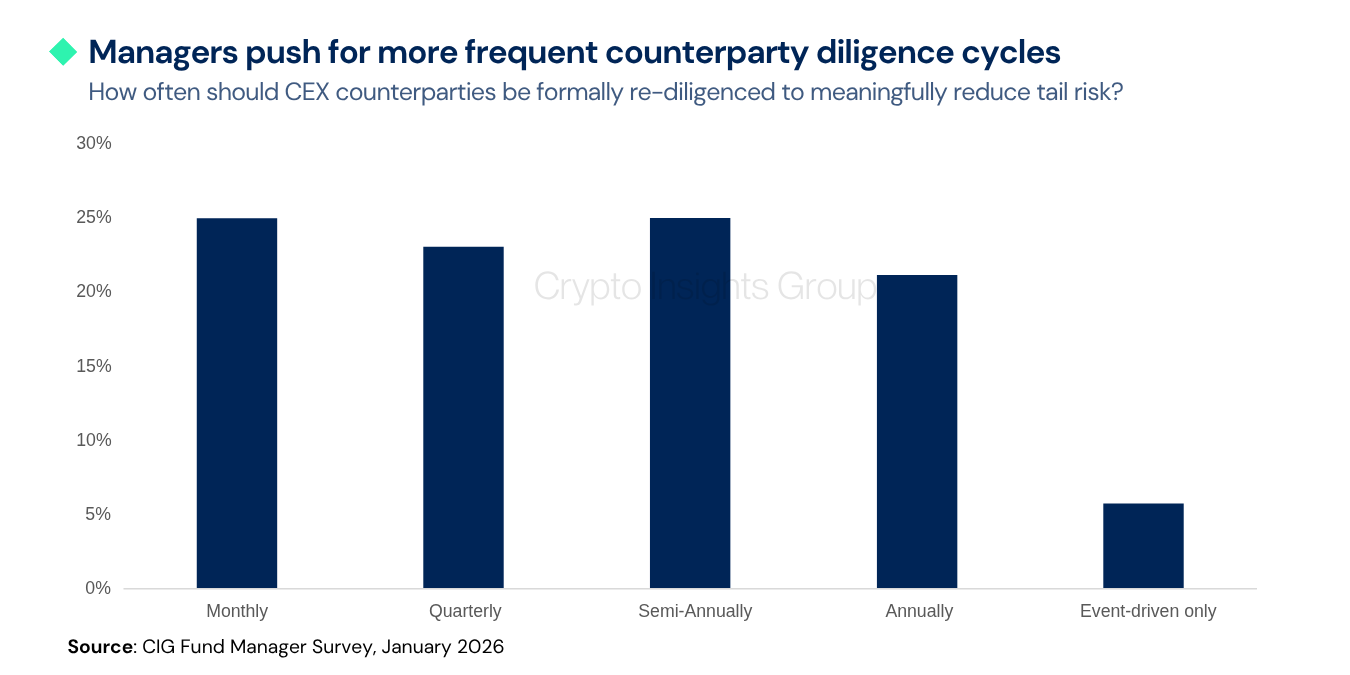
To take the process further, and based on my experience in roles managing counterparty risk at large asset managers, with structured oversight through membership on governance committees, or working with regulators during counterparty due diligence audits, other important considerations and process to be included in institutional counterparty management should also include the following:
For Investment Managers
- The ability to demonstrate, via documentation and process description, not just the onboarding of a counterparty, but the internal methods for which counterparty exposures are tracked across a firm and for each individual client product (i.e, funds and separately managed accounts).
- Presenting a valid process by which counterparty risk exposures are dynamically managed, 24/7, through the use of alerts or having staff work globally/non-business hours, and for systematic strategies, presenting examples or schematics on how algorithms are programmed to respond or take off risk until a human can assess any materials impacts to a portfolio.
- Giving thoughtful responses to questions from clients, or regulators, on options a manager has created for themselves to move exposures between counterparties or complete open position settlement.
For Allocators
- Asking a manager about specific examples of how they responded to industry-wide events (assuming they were operating their respective strategy during a historical time period). For those managers that trade with centralized counterparts, request details on managing exposure to FTX (2022), the liquidation events of October 10 and 11th (2025), and a near ongoing series of cyber incidents, lawsuits, and regulatory penalties impacting numerous trading partners throughout recent years. For DeFi, strategies, inquiring into the response by a manager or curator if their strategies had been exposed to protocol breaches or token extraction events causing liquidity (i.e., bad debt) issues within vaults.
- If applicable, requesting details on technology used for risk management, beyond an alert system or system programming, as detailed above, but whether or not portfolio risk management tools are developed internally or utilized “off-the shelf” to execute real market orders to draw-down exposed capital.
- Requesting evidence that a manager is not just “watching” counterparty risks but are themselves sending questionnaires to counterparties, requesting a trading partner’s audits or financial statements, reviewing control reports (i.e., SOC or ISAE control tests), and updating service agreements for instances such as trading in new financial products or ensuring terms remain fair or bi-lateral throughout the years of a relationship.
For Brokers, Exchanges, Custodians or DeFi Venues
- Developing a culture, and process, by which you can provide transparency for client requests, by preparing institutional standard onboarding materials, including a business-issued DDQ, which should ideally provide responses to common client questions, making the process efficient for you and your clients.
- Providing real time, or near real time, disclosures and updates on addressing publicly-known issues, such as outages, cybersecurity events or assurances on solvency and liquidity, through social media, emails and dashboard alerts (and of course, check with your attorneys first, but make it timely).
- Addressing as directly as possible, public litigation or regulatory violations, by proactively providing statements on the basis of the matter, your organization’s position, and if possible, the timing of any resolution or decision.
Supporting The Mission
As the Crypto Insights Group team is composed of experienced asset managers and allocators, we’ve had the unique perspective of sitting on both sides of the table, where counterparty risk management was always a topic of discussion. Coupled with the added responsibilities of managing crypto counterparty relationships for years, and supporting our clients throughout periods of extreme market volatility, first hand experience counts when it comes to understanding the gaps when conducting due diligence and assessing risk.
However, it is in our work with investment managers, allocators, service providers and protocols that informs our ability to create solutions that bridge the ability to effectuate the flow of capital throughout the digital asset space.
Despite there being nearly endless access to information through blockchains, DeFi dashboards, news, and social media, direct conversations, data, diligence and bespoke research are often scarce resources in a decentralized industry.
Crypto Insights Group helps managers, allocators, and digital asset counterparties build institutional-grade counterparty diligence programs, from DDQ frameworks and ongoing monitoring to exposure reviews and bespoke risk research.
Reach out to learn more on how Crypto Insights Group can help support your crypto counterparty processes, standards and risk management.