Robinhood Chain: What Matters for Allocators

Three months after launch, Robinhood Chain has attracted plenty of activity. Whether that activity becomes durable liquidity, and who earns from it, is still unconfirmed.
Three things matter for funds and allocators: It creates a new execution venue for crypto assets and tokenized equities, opens new liquidity and yield opportunities, and provides a large-scale test of whether a regulated brokerage can convert its distribution into onchain market share.
Robinhood Chain launched its public mainnet on July 1, 2026 as an Ethereum Layer 2 built on Arbitrum's Orbit stack. Robinhood is the chain operator and retains roughly 90% of onchain fees, after a 10% licensing fee to the Arbitrum DAO. The chain is part of Robinhood's broader shift from retail brokerage toward global financial infrastructure provider.
By September 28, DefiLlama reported about $1.02 billion in TVL, $55.3 billion of DEX volume over the prior 30 days and $93.5 billion since launch. Robinhood's 90-day gas subsidy for Robinhood Wallet users expired on September 29, so every figure to date was recorded while gas was free.
Key takeaways for allocators
Our manager panel broadly expects tokenized equity adoption to accelerate, making the more differentiated question where liquidity and economic value ultimately accrue. The questions that matter for allocation are more focused.
- Durable liquidity is unproven. Early activity is concentrated in a few venues and was recorded under a gas subsidy that has now ended. Post-subsidy data over the next quarter is the first real test.
- Economic value is split across layers. Volume, fee revenue and distribution currently sit with different participants. Neither our survey nor the early data points to a single winner.
- The US regulatory path is in development. The SEC's Innovation Exemption creates a five-year, conditional route for onchain trading of tokenized US stocks, with symbol and volume caps. Robinhood's current Stock Tokens are not offered to US customers.
- Diligence should focus on the source of return. Allocators should separate volume exposure, fee capture, carry and token re-rating when evaluating managers with exposure to the chain.
What managers think
Managers broadly agree that Robinhood Chain will accelerate tokenized equity adoption, but they differ on how much and on who will follow.
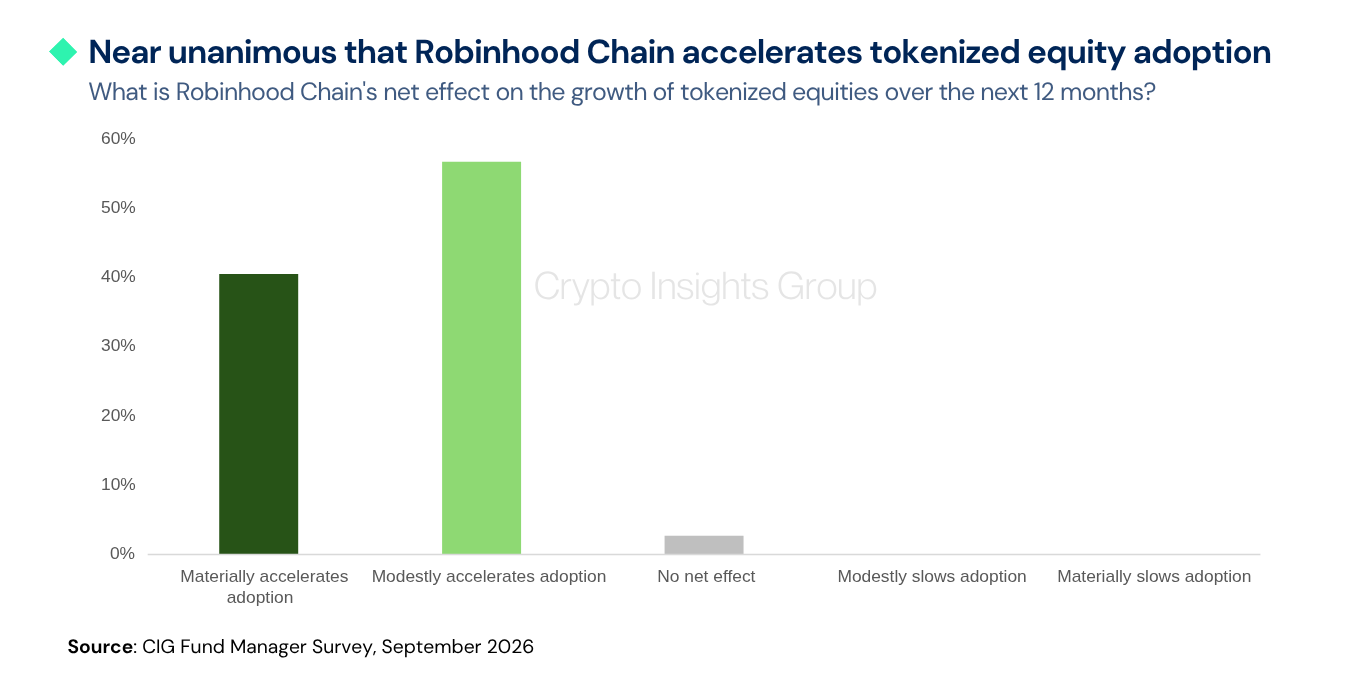
Adoption: Nearly all respondents expect Robinhood Chain to accelerate tokenized equity adoption over the next twelve months. One respondent expects no net effect, and none expect a slowdown. Most chose modest growth, while about 40% anticipate material acceleration. These are only preliminary expectations, and the split on magnitude matters more than the consensus on direction.
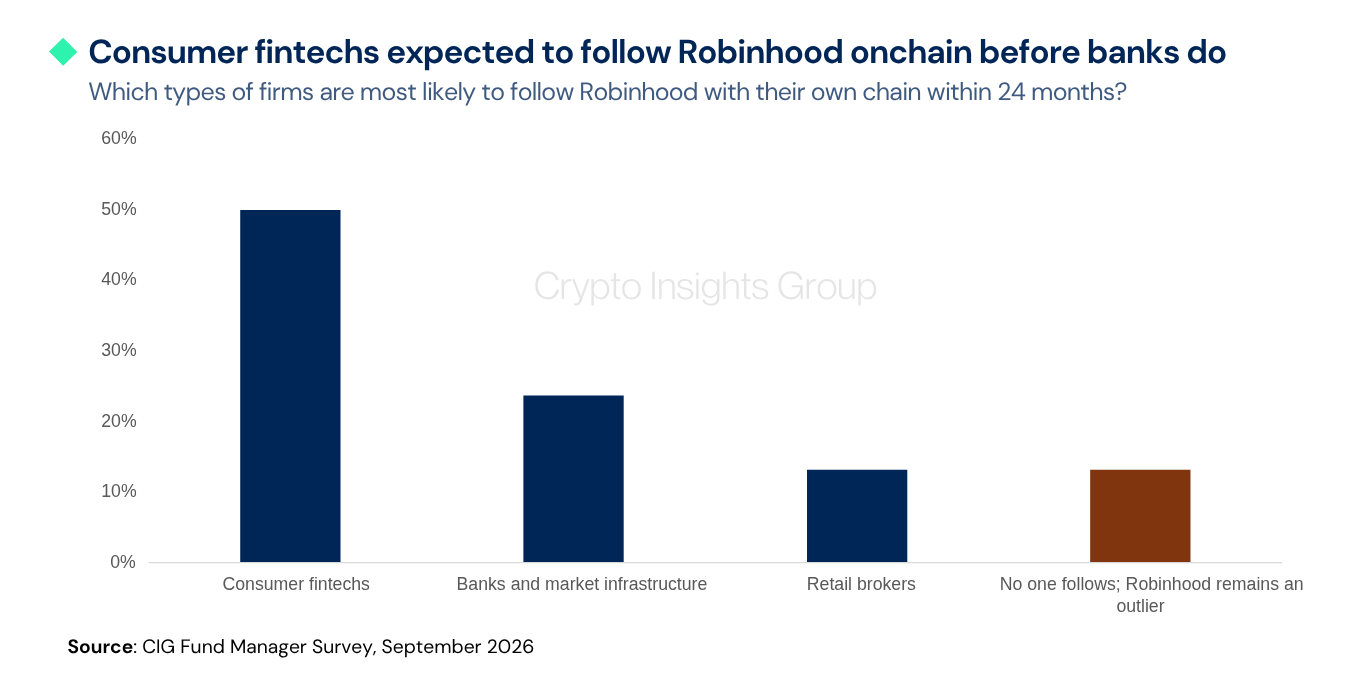
Who follows: Half the panel expects consumer fintechs to launch their own chains within two years. That is roughly twice the number supporting banks and market infrastructure, and well ahead of retail brokers.
Institutional developments may take a different route. The largest US banks are already building a shared tokenized deposit network through The Clearing House with a first-half 2027 launch target. The network will support 24/7 interbank transfers, enabling onchain clearing and settlement of tokenized deposits.
Why this matters for allocators: a manager's opportunity set shapes their view. Liquid managers naturally focus on public chains with tradable tokens. However, a meaningful part of institutional tokenization may develop on permissioned or bank-operated rails where there is no token to own.
What early data shows
Early activity is high but concentrated, largely crypto-native and has occurred with subsidies. There is not yet evidence of durable institutional liquidity.
As of: Sep. 28, 2026, unless otherwise noted. Uniswap share of chain volume and stock tokens as share of chain volume are from early September; tokenized stock balances are from mid-September; USDG deposits via Robinhood Earn are as of Aug. 31, 2026. Sources: DefiLlama; CoinDesk; 51 Insights; Cryptonews; KuCoin.
- Liquidity is concentrated. A single venue (Uniswap) handles roughly three-quarters of chain volume, and launchpads generate a large share of trading, with one platform (PONS) accounting for ~60% of launchpad volume. For funds, concentration means execution quality and exit liquidity both depend on a small number of counterparties and contracts.
- Flow is mostly crypto-native. CoinDesk Research attributes most volume to trading terminals, Uniswap and launchpads rather than Robinhood app users. Robinhood's retail audience has yet to participate, with their own users only making up 1-2% of trading volume as of early September.
- Subsidies shaped the early numbers. Gas was free for wallet users until September 29. Most TVL came from Robinhood Earn stablecoin deposits, where a ~7% user yield exceeded the ~3.7% borrow rate, with the gap funded by rewards. Daily volume was already cooling before the subsidy ended, and daily onchain fees fell roughly 97% from their early-September peak.
- Tokenized equities remain a small share. Stock tokens account for under a tenth of chain volume, and balances trail other chains. The flagship use case is growing from a low base.
Why this matters for allocators: reported figures vary widely by methodology. TVL estimates for late August ranged from about $0.7bn to $1.4bn depending on the tracker. Managers citing chain metrics should specify the source, definition and date.
Where economic value can accrue
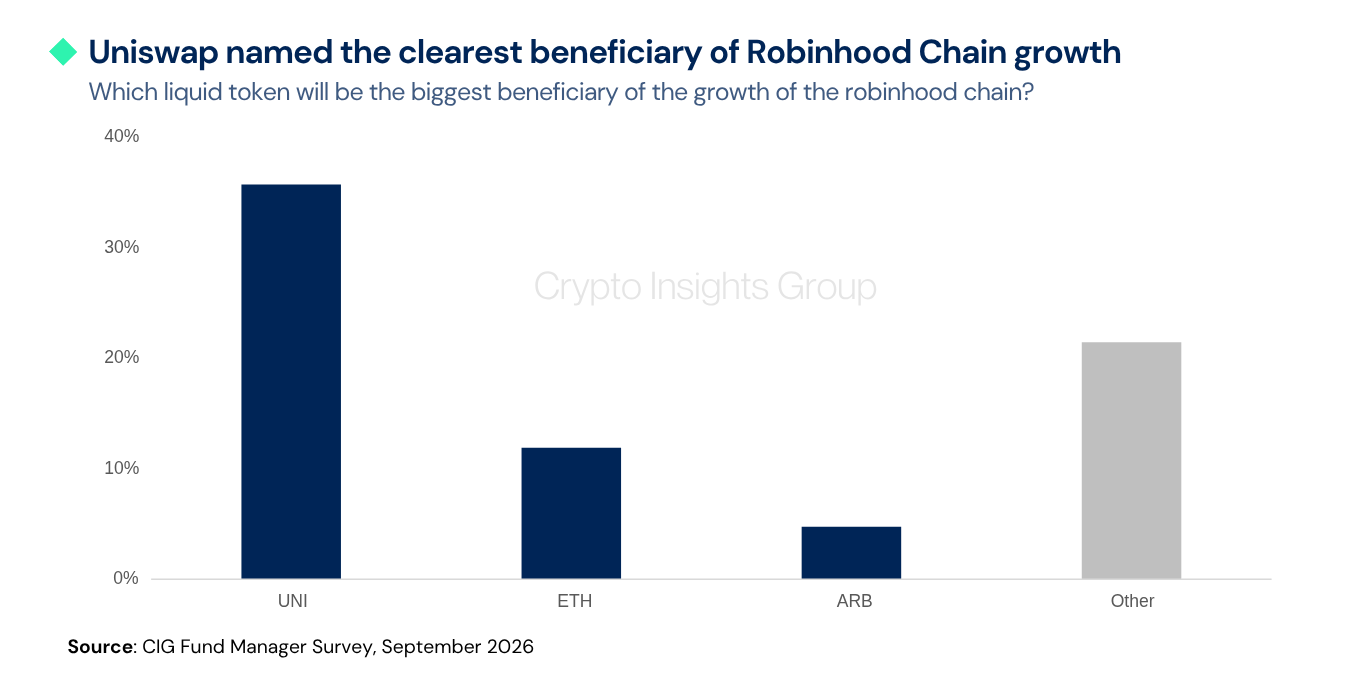
Volume, fee revenue and distribution currently sit with different layers of the stack, and the survey indicates managers are leaning toward the execution venue. When asked which liquid token benefits most from Robinhood Chain's growth, close to 40% of respondents named Uniswap. Ethereum followed at a distance, with Arbitrum, Robinhood equity and individual applications behind.
It is important to note that the layers are becoming linked: Uniswap Labs disclosed a purchase of PONS, the token of the chain's leading launchpad, which blurs the line between venues and applications.
Why this matters for allocators: exposure to Robinhood Chain can mean very different underlying bets. A venue position is largely a volume bet, while an application position is a fee bet with durability risk. A position in Robinhood equity is a distribution bet diluted by the rest of the business.
Implications for fund managers
The more lasting impact for funds is likely to come from changes in market structure, not from any single token.
24/7 trading and price discovery. Tokenized equities that trade 24/7 create price discovery outside US market hours, and with it basis between tokens and the underlying shares. Whether that basis is tradable at institutional size depends on liquidity depth, which remains thin relative to listed markets.
Liquidity provision under a defined framework. On September 17, the SEC issued the Innovation Exemption, after Congress was unable to advance the CLARITY Act. The exemption governs trading venues and liquidity providers. It does not by itself authorize any particular product or venue, and it does not change the status of Robinhood's existing Stock Tokens, which are not available to US customers.
- Access and structure: Fund domicile, counterparties and legal structure determine which of these markets a manager can reach. Offshore stock tokens and US tokenized NMS stock traded on a TSV are different instruments with different rules.
- Carry and collateral: Onchain lending lets stablecoins and stock tokens serve as collateral. Early yields were supported by rewards, so carry strategies should be underwritten at post-incentive rates.
- Operational concentration: Robinhood is the chain operator, and a small number of contracts carry most volume. Funds should treat operator, smart contract and venue concentration as explicit risks.
What allocators should diligence
When evaluating managers with exposure to Robinhood Chain or the broader tokenized equity theme, allocators should focus on five areas.
- Source of return. Is the thesis driven by volume, fee capture, carry, basis or token re-rating? Each carries a different risk profile and a different sensitivity to the end of subsidies.
- Post-subsidy evidence. How has the strategy performed since September 29, and which metrics does the manager use to separate durable activity from incentive-driven flow? Given how early the data is, a defined set of invalidation signals separates a thesis from a narrative.
- Data discipline. Which sources and definitions does the manager use for TVL, volume and revenue? Given the spread between trackers, consistency matters more than the headline number.
- Legal and access structure. Which instruments can the fund legally trade from its domicile? If the manager provides liquidity, has counsel assessed eligibility under the Innovation Exemption's liquidity provider relief?
- Concentration and operational risk. How does the manager handle operator dependence, smart contract risk and venue concentration? What is the exit plan at size?
Conclusion
For allocators, the more relevant question is increasingly not whether tokenized equities develop, but where durable liquidity and economic value ultimately accrue. The open questions are whether liquidity on Robinhood Chain persists without subsidies, and which layer retains the economics as activity shifts from speculative trading toward tokenized equities.
Both questions will become evident over the coming quarter, through post-subsidy volumes, the share of volume in tokenized equities, fee capture by layer, and the first venues operating under the Innovation Exemption. Managers who can show evidence on those points, rather than on adoption alone, are better placed to justify an allocation. CIG will continue to track these developments in future surveys.
Contact us to learn more about ways Crypto Insights Group can support your digital assets program.